
Helminth infections remain a significant challenge in modern poultry production. Around 100 helminth species are known to affect domestic poultry with nematodes being the most prevalent and economically important. The species most commonly encountered are Ascaridia galli, Heterakis gallinarum and Capillaria spp. The shift toward cage-free and welfare‑friendly systems has increased exposure to parasites, but infections also occur in indoor high‑biosecurity systems, confirming their broad relevance. Heterakis gallinarum is of particular concern because it transmits Histomonas meleagridis, exacerbating financial losses.
Helminth infections negatively affect flock performance. Reports indicate a 5 – 15% reduction in egg production, with peak losses reaching 20–30% in heavily infected flocks. Free‑range systems may experience 20–50% higher losses compared to conventional cages. European studies estimate financial losses of €2,000 – €10,000 per outbreak in mid‑sized layer farms. These figures highlight the need for systematic parasite monitoring and strategic deworming.
Monitoring Methods
- Field necropsy
On‑farm necropsy provides immediate insight into worm burdens but requires examination of multiple birds. Smaller nematodes such as Capillaria spp. are easily missed, which may lead to underestimation.
- Sieve method
This laboratory technique improves detection in intestinal content but requires submitting whole intestines, creating logistical limitations for routine use.
- EPG (eggs per gram of faeces)
Fecal EPG analysis is practical, fast, and relatively inexpensive. Proper sample collection from various points within the house is essential. A negative result does not rule out infection, because egg shedding is intermittent. Repeating testing after 3–4 weeks is recommended. Regular EPG monitoring helps determine infection dynamics and optimal treatment timing.
- Flotation method
A qualitative method suitable for detecting larger eggs but less sensitive than EPG. It is useful as an initial screening tool but not ideal for ongoing monitoring programs.
Deworming Strategies
Once infection is detected, timely deworming is essential to prevent reduced egg production, poor feed conversion, intestinal inflammation, weight loss and in severe cases, intestinal obstruction. Benzimidazoles remain the most widely used broad‑spectrum anthelmintics in poultry and are typically administered via drinking water, which simplifies treatment in large flocks.
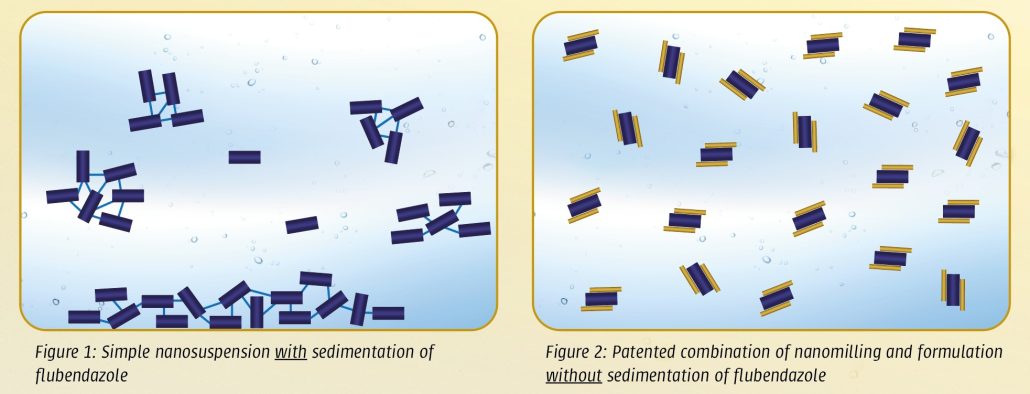
However, benzimidazoles are poorly soluble in water. This can lead to sedimentation, uneven distribution, fluctuating concentrations in the drinking system and the risk of underdosing—potentially reducing efficacy and increasing resistance pressure.
Fludosol®: A New Approach to Reliable Deworming
To address these challenges, Dopharma has developed Fludosol® 200 mg/ml, an innovative flubendazole formulation designed for optimal dispersion in drinking water. Thanks to nanomilling technology and patented formulation, Fludosol® prevents sedimentation and ensures consistent homogeneity throughout treatment.
In practice, this means:
- Continuous 24‑hour dosing with only a single stir required after 12 hours
- Uniform exposure of all birds to the active substance
- Reduced risk of underdosing and resistance development
- No need to restrict water before treatment
- Lower stress for birds due to stable water access
- Reliable stability in both soft and hard water and during storage
These features support consistent and effective deworming in commercial poultry flocks.
Conclusion
Rising helminth prevalence in modern poultry production requires a comprehensive and proactive approach. Regular monitoring, appropriate diagnostics and effective deworming strategies are essential to minimize losses and support sustainable production. Innovative products such as Fludosol® provide practical and reliable solutions that improve treatment outcomes and flock welfare.
If you would like to explore parasite control strategies or learn more about Fludosol®, Dopharma’s Technical Support team is ready to assist you. You can contact us via [email protected].

Sylwia Doner
Technical Support Veterinarian Poultry
