
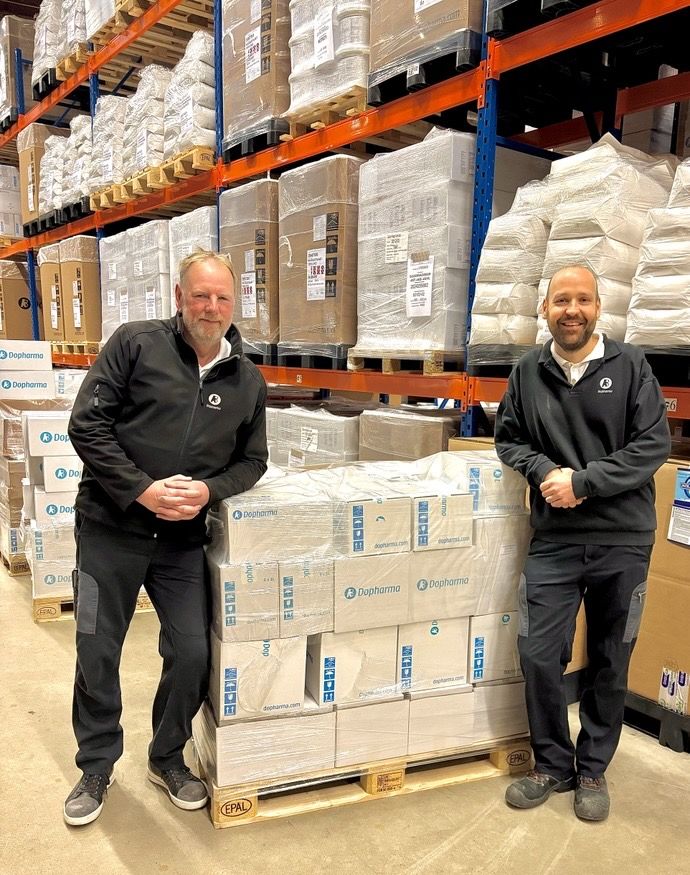
Can you introduce yourself? And what is your main responsibility/task?
Adrie:
My name is Adrie van Vuuren. I’m 62 years old and I come from Sliedrecht, the Netherlands. I’ve been working at Dopharma for about 38 years, and I’m employed as a warehouse worker for the Export division. My job involves ensuring that all containers with products are shipped by trucks, containers, and airplanes. In my spare time, I enjoy listening to music and like to travel with my camper during the weekends.
Ronald:
My name is Ronald van Dortmont, I’m 32 years old, and I’ve been working at Dopharma for 10 years as a warehouse worker for the Dutch branch. My main tasks include supervising colleagues and processing orders. Additionally, I assist with Export tasks. After work or in the weekends, I like cycling various routes on my gravel bike and I enjoy running.
What is the biggest difference between handling Dutch orders and export orders within and outside the EU?
Adrie:
Export orders are usually pallet-based, with about 23 pallets fitting in one container. In contrast, in the Netherlands, products are handled individually. Everything stored in my warehouse is already sold. The items in the Dutch warehouse are mostly stock and still available for sale.
Ronald:
Orders for the Netherlands and Belgium are processed in smaller quantities. We pack those orders into boxes. Our own drivers deliver these orders to veterinary clinics in different regions. Occasionally, a pallet might need to be shipped within the Netherlands, but those are sent with external carriers. Recently, we also started delivering to customers in Germany from our warehouse, which happens three times a week.
What are the main differences in the administrative tasks for the orders?
Adrie:
I receive my orders from the Customer Service department and then I put the information into a file. In that file, I specify what exactly is on each pallet and how much it is, including the pallet’s weight. Usually, I get two days to prepare an order, and by the end of that period, the order needs to be ready for shipping.
Ronald:
I receive orders from Customer Service, which helps me estimate how many boxes I’ll need. Once I know that, I prepare stickers for the boxes. For export, the details about what’s on a pallet are very specific, while for Dutch orders, we don’t have that level of detail for the boxes.
What does a typical workday look like for you?
Adrie:
My workday usually starts at 7:15 AM. I start checking what orders I’ve received. If there’s an order from the day before that isn’t finished yet, I continue with that one. I follow a schedule that clearly outlines which orders are incoming and where to start. This schedule is based on a color system: red means that I work on that order, green means that the order is completed, and orange indicates that the order is started but not finished yet. With this system, everyone knows what I’m working on. My workday ends at 4:15 PM, and I have Fridays off.
Ronald:
I often start at 8:00 AM. First, I replenish the stock so that we’re ready to process all orders. Throughout the morning, orders for our own transport come in. Customers can place orders until 4:30 PM, but if they order before 1:00 PM, they receive their delivery the same day. At 1:00 PM, the drivers start their shifts. Sometimes they help with order picking before leaving around 2:00 or 2:30 PM for deliveries. Orders placed after 1:00 PM are sent via external carriers and delivered the next day. In between, I help with palletizing and restocking products.
What do you enjoy most about your job?
Ronald:
The variety! Every day is different. You’re always on the move in the warehouse, and there’s a shared motivation to finish everything by the end of the day. That gives everyone a sense of accomplishment.
Adrie:
I’ve been doing this job for quite a long time, and it’s still enjoyable and challenging. The bigger the order, the more I enjoy it!
What’s the biggest order you’re currently working on or have ever handled?
Adrie:
We’re preparing a delivery for Algeria that consists of multiple orders spread across 10 containers — about 200 pallets in total! That’s quite a lot. We also send out about two trucks to Poland every week, so I have enough to do!
Can you share a funny or memorable anecdote from your work?
Adrie:
Back in the day, there were fewer rules, so we could get away with more. We used to play pranks on each other and even on other departments—things you couldn’t get away with nowadays! That was over 30 years ago. But we still manage to have fun together during work.
Ronald:
A few years ago, the company organized a weekend trip to the Belgian Ardennes, which was a lot of fun! I also occasionally go out for drinks with a group of colleagues from other departments.
Earlier editions:
